Standing Waves: The Architecture of the Real
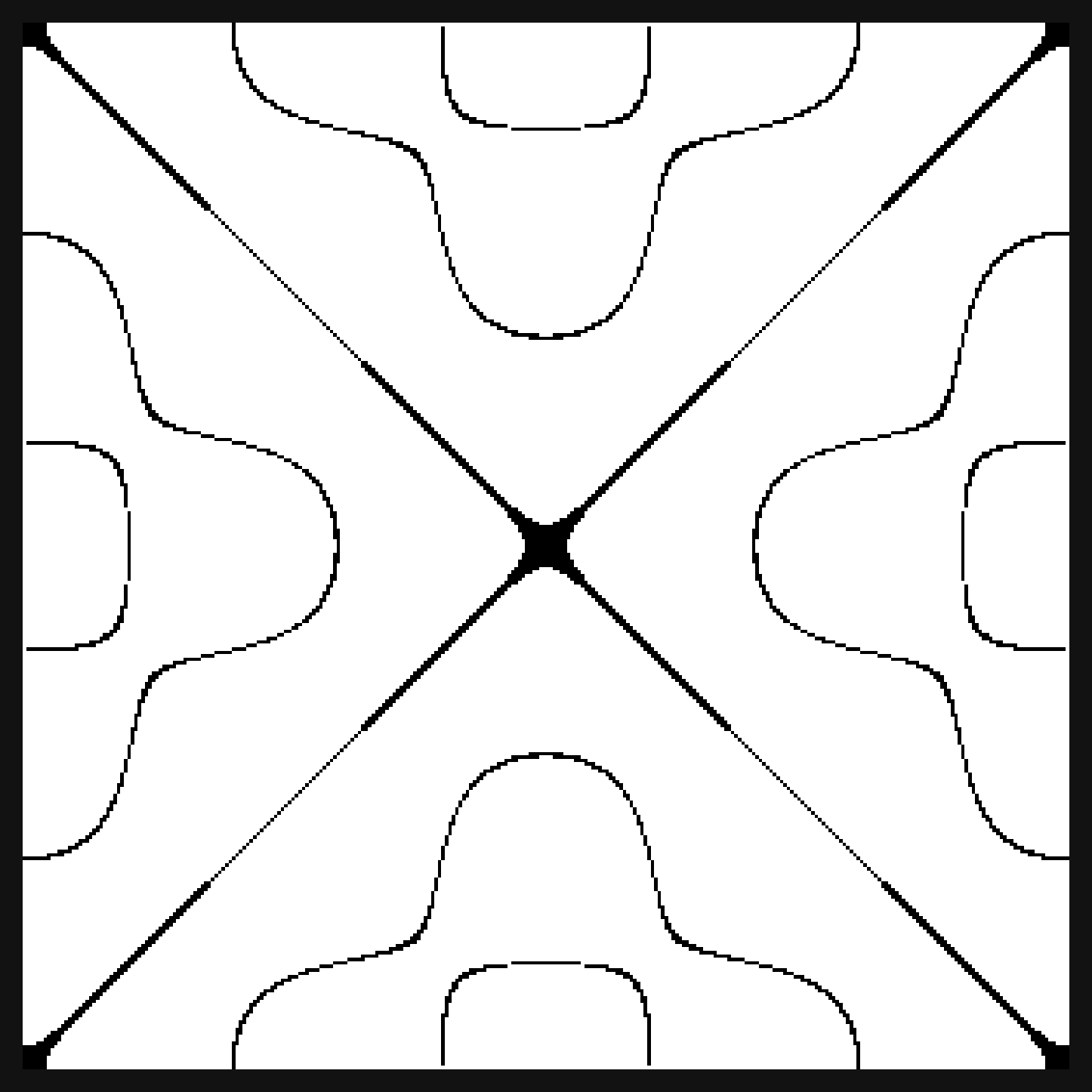
Matter is not a thing. It is a pattern that persists—a standing wave in the medium of spacetime.
What Stays While Everything Flows
Pluck a guitar string. You see it vibrate—a blur of motion. But the vibration is not random. The string moves in a specific pattern: maximum displacement at certain points (the antinodes), zero displacement at others (the nodes). The nodes don’t move. They stand still while the string vibrates around them.
This is a standing wave: a wave pattern that stays in place. It arises when two waves of the same frequency travel in opposite directions and interfere with each other. Where they reinforce, the amplitude doubles. Where they cancel, the amplitude drops to zero. The result is a pattern that oscillates in time but remains fixed in space.
Standing waves are everywhere. They are, arguably, the architecture of everything that exists.
Atoms Are Standing Waves
In quantum mechanics, the electron is not a particle orbiting the nucleus like a planet around a star. It is a wave function—a mathematical description of probability amplitude spread through space. Only certain wave functions “fit” around the nucleus: those whose wavelength divides evenly into the circumference of the orbital. These are standing waves.
This is why atomic energy levels are discrete—why electrons can only occupy certain orbits and not others. It is the same reason a guitar string can only produce certain harmonics: only wavelengths that fit between the boundaries are allowed. The chemistry of the entire universe—every element, every bond, every molecule—follows from standing wave conditions in the quantum realm.
Cymatics: Sound Made Visible
In the eighteenth century, Ernst Chladni sprinkled sand on a vibrating metal plate and watched the sand collect at the nodes—the places where the plate wasn’t moving. The patterns were extraordinary: geometric, symmetrical, organic. Different frequencies produced different patterns—mandalas, lattices, forms that looked like living things.
This is cymatics: the study of visible sound. It demonstrates, in a way no equation can, that vibration creates form. Sound makes shape. Frequency determines geometry.
The implications are profound. If matter at the quantum level consists of standing waves, then the visible forms of the world—crystals, cells, organisms, galaxies—are Chladni patterns at different scales. The universe is not made of things; it is made of vibrations that have found stable patterns.
The Cosmic Background
The cosmic microwave background—the oldest light in the universe, released about 380,000 years after the Big Bang—shows patterns that may be standing waves from the early universe. These are called baryon acoustic oscillations: sound waves in the primordial plasma that were “frozen in” when matter and radiation decoupled.
The largest structures in the universe—galaxy clusters, filaments, voids—may bear the imprint of these primordial standing waves. The cosmic web, stretching billions of light-years, is a Chladni pattern on the largest possible scale.
You Are a Standing Wave
Consider your body. Every atom in it will be replaced within roughly seven years. The matter flows through you like water through a wave. Yet the pattern persists. Your face, your fingerprints, your neural architecture—these endure while the material substrate is continuously exchanged.
You are not the water. You are the wave. A stable pattern in a flowing medium. A standing wave in the medium of spacetime.
This is not metaphor. It is the most precise description available.
Further Reading
Arthur Benade, Fundamentals of Musical Acoustics (Dover, 1990)
Thomas Rossing, The Science of Sound (Addison-Wesley, 1990)
Hans Jenny, Cymatics: A Study of Wave Phenomena and Vibration (MACROmedia, 2001)
Brian Greene, The Elegant Universe (Norton, 1999)
Watch
Cymatics: Chladni Plate experiments—sand on vibrating plates, demonstrating how frequency creates form.