The Fourier Bridge: How Infinity Hides in Every Wave
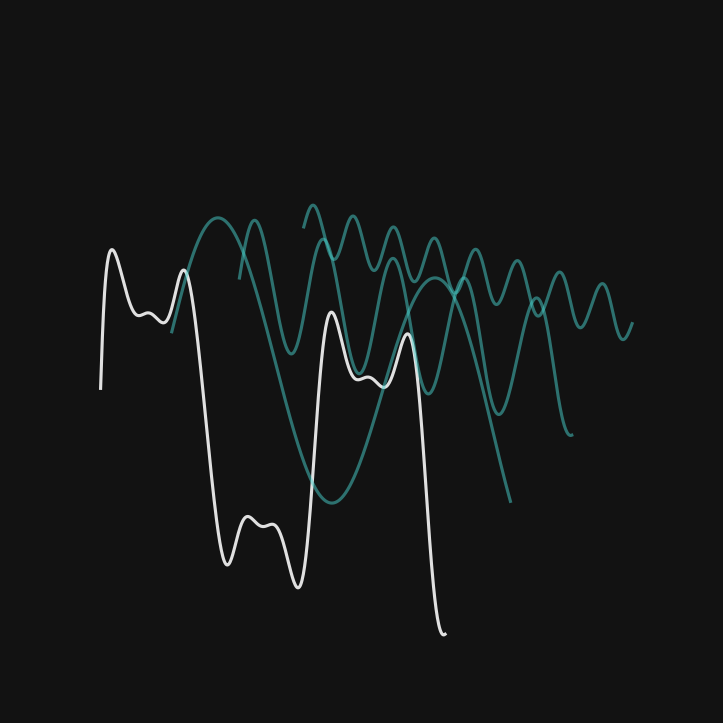
Any complex wave can be decomposed into simple sine waves—and vice versa. This is one of the most powerful ideas in mathematics. It may also be the key to understanding the relationship between the material world and whatever lies beyond it.
Fourier’s Theorem
In 1807, Joseph Fourier made a claim so bold that the leading mathematicians of his day—Lagrange among them—refused to believe it. Fourier asserted that any periodic function, no matter how jagged, discontinuous, or complex, could be represented as a sum of simple sine and cosine waves.
He was right. And the implications have been reverberating through mathematics, physics, and engineering for two centuries.
A jagged waveform, a spoken word, a musical chord, an image, a heartbeat—anything that varies in time or space can be analyzed into a sum of pure sine waves of different frequencies, amplitudes, and phases. The complex is built from the simple. The many are secretly one.
The inverse is equally true: combine sine waves and you can build any waveform you like. A synthesizer does this—adding frequencies to construct sounds that never existed in nature. Fourier synthesis is creation from first principles: start with the simplest possible oscillation and, by combination, generate arbitrary complexity.
Two Domains
Fourier analysis reveals that every signal exists simultaneously in two domains. In the time domain, you see the waveform as it unfolds—amplitude changing moment by moment. In the frequency domain, you see its components—which pure tones are present and in what proportions.
These are two complete descriptions of the same reality. Neither is more “real” than the other. The time domain shows you the story as it happens; the frequency domain shows you the ingredients the story is made from. The Fourier transform is the bridge between them—a mathematical operation that translates perfectly from one description to the other and back again.
This duality is not a quirk of the mathematics. It is built into the structure of physics. Heisenberg’s uncertainty principle—that you cannot simultaneously know a particle’s exact position and exact momentum—is a direct consequence of Fourier duality. Position and momentum are conjugate variables, related by the Fourier transform. To pin down one is to blur the other. This is not a limitation of our instruments. It is a feature of reality.
The Bridge
Consider the possibility that the material world—the world of time, change, cause, and effect—is the time domain. And that there exists a frequency domain: a realm of pure forms, eternal patterns, simple harmonics that, combined, produce the complexity of everything we experience.
This is not a new idea. Plato called the frequency domain the realm of Forms. The Pythagoreans heard it in musical ratios. The Vedantic tradition calls it Brahman—the unchanging ground from which the changing world arises. What Fourier’s mathematics offers is a precise, formal description of how these two realms relate. Not metaphor. Mechanism.
The material world is the complex waveform. The divine world—if we may use that word—is the set of pure frequencies. The Fourier transform is the bridge between them. And the bridge goes both ways.
The Brain Already Knows This
The brain performs Fourier-like analysis constantly. The cochlea in the ear decomposes sound into frequency components—it is, physically, a Fourier analyzer. The visual cortex extracts spatial frequencies from images. Perception is analysis. We literally decompose reality into its harmonics, every moment of every day, without being aware of it.
Itzhak Bentov suggested that meditation is a kind of inverse Fourier synthesis. The ordinary mind is noisy—many frequencies, incoherent phases, a complex waveform. Meditation progressively eliminates frequencies, simplifies the signal, until in the deepest states only the fundamental remains—or perhaps no frequency at all. Pure DC. The unmoved mover.
Watch This
For a beautiful visual explanation of the Fourier transform, I recommend Grant Sanderson’s (3Blue1Brown) video: “But what is the Fourier Transform? A visual introduction”. It is the clearest twenty minutes you will spend on this subject.
Also essential: “But what is a Fourier series? From heat flow to drawing with circles” — the companion video that covers Fourier series specifically.
Further Reading
Joseph Fourier, The Analytical Theory of Heat (1822; Dover reprint)
Elias Stein & Rami Shakarchi, Fourier Analysis: An Introduction (Princeton, 2003)
Itzhak Bentov, Stalking the Wild Pendulum (Destiny Books, 1977)
Steven Strogatz, Infinite Powers (Houghton Mifflin, 2019)