The Secret of Pi
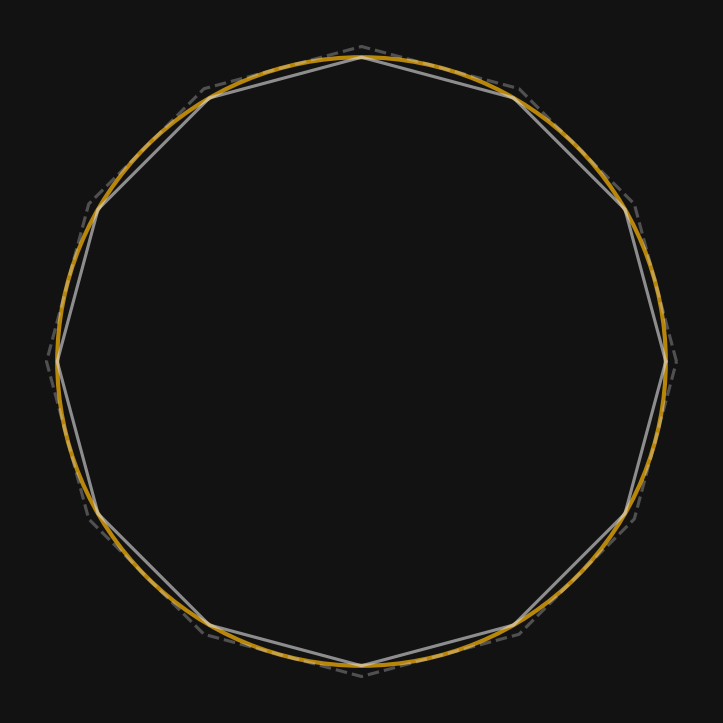
Why this website bears the name it does.
π is approximately 3.14159..., but never exactly anything. It is transcendental—a word mathematicians use with precise meaning. A transcendental number is one that cannot be the root of any polynomial equation with integer coefficients. It cannot be captured by any finite algebraic expression. It is, in a rigorous sense, unreachable by finite means.
This was proved in 1882 by Ferdinand von Lindemann, settling one of the oldest problems in mathematics: you cannot square the circle with compass and straightedge alone. The ancient geometers had spent millennia trying. The impossibility is not a failure of technique. It is built into the structure of π itself.
The alchemists understood this, even without Lindemann’s proof. They adopted “squaring the circle” as a symbol for the Great Work—the transformation that reconciles opposites. The impossibility was the point. The Work is not about arriving at a final state but about the eternal process of approaching what cannot be fully grasped.
π in Physics
π appears wherever circles appear, and circles appear everywhere. Every oscillation, every wave, every rotation passes through π. The period of a pendulum. The orbits of planets. The probability distributions of quantum mechanics. The curvature of spacetime itself.
But π’s reach extends far beyond geometry. It appears in Euler’s identity:
eiπ + 1 = 0
This single equation connects the five most fundamental constants in mathematics: e (the base of natural logarithms), i (the imaginary unit), π (the ratio of circumference to diameter), 1 (the multiplicative identity), and 0 (the additive identity). Feynman called it the most beautiful equation in mathematics. It is a rotation—π radians through the complex plane—that takes you from the positive real axis to the negative. From here to there. From life to its mirror image.
The Transcendence
What does it mean, philosophically, that the most basic ratio in geometry is unreachable?
It means the finite contains the infinite. Every circle you draw—with a compass, with your finger in sand, with a satellite’s orbit—encodes a number with no end, no pattern, no periodicity. The boundary of the simplest shape contains infinite information. There is no escaping this. It is not an artifact of our measurement system or a failure of our notation. It is a fact about the structure of space itself.
This is the first secret of π: infinity is already here, embedded in the most familiar forms.
The Journey
The second secret is more subtle. Because π is transcendental, any attempt to express it exactly requires an infinite process—an infinite series, an infinite product, an infinite continued fraction. You can get closer and closer. You can calculate a trillion digits. But you will never arrive.
The journey toward π never ends. And yet the circle is right there, whole and complete, every time you draw it. The unreachable number produces a reachable shape. The infinite process yields a finite result.
This is the second secret: the journey toward the unreachable is itself the destination. The process of approaching what cannot be grasped is not failure—it is the very structure of existence.
You are already infinite. The circle of your consciousness cannot be squared because it was never meant to be.
That is the secret of pi.
Further Reading
Petr Beckmann, A History of Pi (St. Martin’s Press, 1971)
Jonathan Borwein & Peter Borwein, Pi and the AGM (Wiley, 1987)
Eli Maor, e: The Story of a Number (Princeton, 1994)
Paul Nahin, Dr. Euler’s Fabulous Formula (Princeton, 2006)